Thursday, October 4, 2012

Massage Therapy Travel Log

Checking out other massage practices is something I enjoy, especially when traveling. It gives me new ideas and it's just cool to see how other massage therapists conduct themselves. This summer I went to Central America and had massages in both Honduras and Guatemala. In Honduras, I stayed at La Casa de Cafe, a B&B in Copan, where two of the staff provided massage for the guests in an outdoor ramada right next to my room. It had a roof with open walls on three sides and billowing white curtains that offered privacy yet allowed the breeze in. The massage ramada was equipped with a sink, lighting, a few shelves for storage and over looked a dewy pasture where cows quietly grazed.

The therapist that worked on me was a local with one year of experience. She'd graduated from a 500 hour program in Sao Paula, which is the nearest city and about an hour away. She listened and honored my request for gradual pressure with no forceful adjustments. Her boss asked me for an honest critique after the massage as she was going through a trial period and he was concerned her pressure wasn't as deep as his current therapist. My reply to him was that was a good thing as his guests more than likely would have various preferences for pressure. A more valued quality in a therapist is their ability to listen to the client and vary the massage according to those needs, which this gal accomplished (even with my limited Spanish and her limited English).
 
In Antigua, Guatemala, I visited the Prana Holistic Center. They had several massage therapists on staff, as well as a psychologist, chiropractor, and a few other health care practitioners.  Prana had a couple lovely massage therapy rooms and a large yoga area that faced a lush, green, courtyard. They offered a variety of modalities as well as several different yoga classes. They were having a baby class when I arrived, promoted as a bonding time with parents. The owner had two little ones herself and still took the time to show me around and answer my questions, all the while with her youngest slung across her hip.

Another massage therapist, who had worked in different massage centers around the world, visited with me too. She'd been trained in Canada and both she and the owner had graduated from 1200 hour programs. They'd been working as massage therapists for several years and had a more holistic approach with clients.

Although both massage locales were different in their presentation (spa vs. holistic) they tailored their sessions to the person on the table and provided a tranquil, relaxing environment. I hope to go back someday and if you get the chance to visit, don't hesitate.


Sunday, August 19, 2012

The Ergonomics of Parenting


     Lately, several clients have come in with pain issues that might be avoided with a review of their environmental influences. Usually these influencers are related to the work environment but home and family also play a role in ergonomics. Here's an article I wrote several years ago to address some of these issues.

      Ergonomics is the science of making improvements to your work space and daily tasks to more efficiently fit your body and routine.  Its goal is to prevent pain and injury.  How does ergonomics apply to parenting?  Many mothers and grand parents of young children sustain injuries from lifting and carrying them longer than they should.  Once a child starts walking they should be weaned from these behaviors as they can cause wrist, forearm, and shoulder injuries as well as lower back pain to the adult from their repetitive nature.  A better position to address a young child’s needs is getting down to their level by squatting, kneeling, or bending to eye level.  Holding their arm while speaking, hugging them, or sitting down and holding the child in your lap will meet their need for love and attention without increasing your own risk of injury.  The warning signs that can occur in your hands, wrists, arms, shoulders, neck, hips, or back include:
 
  • Numbness, burning, or tingling
  • Soreness, aching, or tenderness
  • Pain, throbbing, or swelling
  • Tightness or stiffness
  • Weakness or cold
      Using proper body mechanics when you do pick up a younger child will help prevent injury.  Bend your legs, keep your back straight, and then lift.  Position your body squarely in front up them and not off to the side swinging them up to your hip as many moms do.  This throws off your center of gravity and can hurt you.  Carrying your toddler on your hip often throws it out of alignment resulting in pain as well.  Varying positions frequently and switching hips is helpful.  As the child’s weight increases so does your risk of injury.  Putting your child in the car seat is another potential area for injury.  Keep the seat as close to your body as possible as you secure them; leaning out while carrying weight is much more of a load to the lower back.

      Another piece of the puzzle not often thought about in preventing pain and injury, is wearing shoes at home.  Many of us, here in Tucson, have hard surfaces we walk on in our homes such as tile, hardwood, or stained concrete.  Running around barefoot increases your potential for joint and lower back pain as the force from a hard surface with no give compresses the bones and vertebra.  A shoe or slipper offers arch support, shock absorption from the cushioned insole, and protection from the scorpions and spiders that live in the desert with us.  If you’re feeling lower back or hip pain think about these behaviors and how you can adjust to better prevent injury.  This not only makes for a healthier parent, it models safe behavior to your child as they learn and grow from watching you.

Tuesday, May 15, 2012

Goldilocks and the Three MTs


Finding the right massage therapist (MT) can really be a challenge. I know as that's what I've been up to lately and it's taken a bit of effort even for me. I was dealing with shoulder pain and needed more than just relaxation but also didn't want it to become worse as the result of too aggressive treatment. I wanted someone to give me the massage my clients receive; pain free, customized AND with relaxation. Finding the right MT is similar to finding most health care professionals. We want someone in a nearby location we connect to and who has the skill, education and experience to deliver.

Like Goldilocks, it took three tries before finding what I needed in a MT. The first one did not listen well and was too hard. She was all about her advanced training theory in a particular modality (please, we all have advanced training) with the philosophy it has to hurt before it gets better (not true). Needless to say, I won't go back to her again.

The next MT gave a relaxing session but was too soft. She didn't seem to know what I meant when asked to focus on my area of pain (although she'd nodded in agreement). She had a routine and was stuck to it. I may go back to her again at some point, but only if a relaxation massage is in order.

Finally, the third MT was juuuuuust right. She listened carefully to what I told her and used a gradual approach with increasing pressure based on my body's reactions and to verbal feedback. When I needed more pressure I asked for it and she obliged. This MT actually had the same advanced training as the first one I'd seen but a whole different philosophy on approach. I've seen her twice now; after giving her additional feedback regarding the first session she has adjusted accordingly. She's a keeper.

So, here's what I learned from my recent experience that might help you in finding the right MT:

1.     Ask someone you know for a referral. Word of mouth from someone you trust counts for a lot in finding a new MT. This can save you time and expense in narrowing your search.
2.      If you don't have a referral and are starting from scratch, go to the two largest MT professional association provider lists: AMTA and ABMP. They'll give you local therapist’s contact info and list their skills and experience.
3.     Check out their websites to see how you relate to them and find out if they're within your budget.
4.     Call the MT or send them an e-mail asking questions related to your purpose in seeking the massage. Keep the dialog going until you feel you're in good hands. The most important questions I asked after explaining my situation were:
                           "What is your approach to addressing shoulder pain?"
                           "Do you think it has to hurt first to get better?"

              5.   Your appointment:

                       How much availability does this MT have?
                             Does their schedule work for you?
                       Did you complete an intake form?
                       Did you create a treatment plan together?
                       Was it based on your health history/session goals?


                  6.   The treatment session:

                             The MT should ask about your comfort at the start.
                                   Ex: support for your back, feet, neck; room temp.
                             Does draping agree with your degree of modesty?
                             They should check in about pressure during the session.
                             Give feedback.
                                   Ex: "back off a little" or "deeper please."
                             The MT should adjust pressure based on your feedback.
                             Ask questions or remain quiet; you set the pace.

After the session, did you feel attended to or disappointed? You'll know if the MT is someone you can work with after the first visit. In my experience, it’s a combination of the massage therapist   appropriately addressing the pain issue, communication, and adjusting to feedback. As with any client/practitioner relationship, your experience is unique to you. Every MT is different based on their education, technique and experience. Keep trying until you find your best fit. Good luck!

Wednesday, April 4, 2012

Pain - The Ultimate Body Cue

Is this you?
     We’ve all suffered pain; most of us try and avoid it - sometimes to our own detriment. Pain (and it's precursors) should never be ignored; rather, it should guide us. Pain in this sense has a purpose; to keep us from further injury. Take for example, low back pain (LBP). By the time you’ve reached your forties you’ve more than likely experienced some episode of pain, stiffness, and limitation in regards to your lower back. Often this resulted in time off from work, fun activities, and adequate sleep, to say the least.

     Which is why future episodes of LBP should guide your current decision making. If you’ve been raking the yard all morning and your back starts to hurt, do you acknowledge it and stop for the day or push on into the afternoon until the task is complete (regretting it the next morning)? How about road trips? You can drive until the full tank of gas is gone ignoring the dull ache that has slowly started creeping up your spine or you can stop every two hours to fill up and move around. With this change of position you improve your circulation through movement and it will
make a difference to your body.

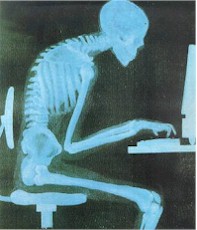
     Most of us work with computers these days and know what a time suck they can be. Before you realize it, you’ve been sitting there for hours. One way you can deal with this lack of motion is by varying your job tasks so you are forced to get up and move around. Keeping books, files, the printer, even the stapler out of your reach has it's benefits by getting you up and moving. If you have to, set a timer to go off every 30 minutes and then stand for a second, do the been sittin too long shimmy (shift your hips back and forth), and then sit back down. If you’re working on a laptop, try moving it to a higher level, like a counter top or cabinet, where you can stand and work for a while. There are also many sit/stand work options available these days to support these efforts (here's an interesting large scale case study on health care cost savings at a company utilizing adjustable work options).

    Make sure you’re not leaning into the screen either, which can wreak havoc on your neck or upper back as well as contribute to LBP.
The rule of thumb is, your line of reading should be approximately two inches below the top of the screen. Adjust the height of your chair, if you can, or elevate your monitor in some way (text books are good for more than just reading). The point being, don’t ignore your pain or be afraid of it; do let it guide you in your decision making process. For those of you who spend your entire day at the computer, you may be interested in this office yoga or a free download with pop-up reminder exercises you can do at your desk (it's not just for kids). Remember to pay attention to your other body cues too, such as:

  • Numbness, burning or tingling;
  • Soreness, aching or tenderness;
  • Pain, throbbing or swelling;
  • Tightness or stiffness;
  • Weakness, fatigue, or cold.
     Of course, this article has been about physical stressors on relatively healthy individuals. The stress most of us are more familiar with, anxiety, also plays a significant role in contributing to pain (I'll blog about that another time.) I should also mention there's a lot we don't know, both in clinical practice and research, about LBP. The recommendations made here are observations from my own clinical experience with clients and the science literature I've reviewed. However, there is growing evidence that massage therapy has the potential to help you manage both anxiety and pain while increasing your awareness of body cues, thus reducing your risk of injury and illness.

Tuesday, November 29, 2011

Using the Evidence to Promote Your Practice

These days it's not difficult to find sources for massage therapy (MT) research information. Pop in on FaceBook and many practices have their own page. Several of them post research articles as a way to promote MT and don't mind sharing (like mine).  Maybe we should define what a research article is. A research article has been peer reviewed and published in a scientific journal. It's usually based on an investigation of a subject the authors were interesting in learning more about and they want to communicate their findings to other interested parties. Here are some great FaceBook evidence resource pages:


Often, you'll hear someone say, off hand, they're doing research on something they're interested in learning more about. This is a form of expanding one's knowledge but it is different than the research we're talking about here. Research in MT uses the scientific method. Additionally, many students are required to write a "term paper", not usually a research paper. A term paper is most often a review of the scientific literature (referred to as a lit. review). There's not usually any actual, hands on research being conducted (although, sometimes there is).

Here is a link from Columbia University that explains the research article format. It's pretty standard and helpful for reading through a research article. Let me just say, it takes a while to fully comprehend what you're reading in a research article. How could you, unless you've been on a research project or gone through graduate school? For the time being, just read through the abstract. The abstract is a summary of the research article. Read the background (AKA the intro) and then skip down to the conclusion. If you're still interested, then see what methods they've used in this study. After the methods, check out the results. Then, it's good to read the intro and the conclusion again (because by now the 'ole brain is clicking). If you're still interested, now's the time to read the entire article.

Why should we care about research anyway; we just want to practice, right? Lots of reasons including:

  • Other health care practitioners will take us seriously;
    (because it puts us all on the same page).
  • Research helps us understand our work;
    (at a deeper level and it WILL make you a better practitioner).
  • You can use research to promote your practice;
    (which is what this blog is getting to).

Research articles provide evidence of the effects of an intervention; in this case, the intervention is massage therapy. Because of the evidence, we can now say massage therapy is effective for decreasing anxiety, depression, blood pressure, and heart rate. We also know there is evidence that MT might be effective for non-specific lower back pain (both sub-acute and chronic). Massage therapy has also been found to increase the weight of pre-mature infants. You can use this information to support and promote the treatment you provide. Potential clients like this data, the bio-medical community respects it and you will gain confidence in your work as a result of knowing the evidence exists (that's how it's most often referred to in science, as evidence, not so much as research).

A few tangible ways of providing the evidence that I've heard other MTs say they've found success with:

A. Printing off the article and providing it to clients in the reception area of your practice;

B. Sending abstracts to clients via e-mail;

C. Taking several abstracts along to doc visits, fitness centers, networking events or where ever else you are trying to establish a MT referral source;

D. Posting it on your FP page, LinkedIn, Twitter, or any other social media site.

Here are two of the top online sources to finding MT research articles:

    You might find the Massage Therapy Foundation (MTF) site easier to navigate the first time around. The MTF site has a wealth of other valuable research information too. Both links ultimately end up at PubMed, which has many science journals and is a good place to get to know if you're really interested in the MT evidence. When you do a search on PubMed, clear the search box (click on the tiny x at the right), type in the area of interest, and massage. For example, you could start by typing: "non-specific lower back pain AND massage." Currently, this search results in 15 articles. If you look to the right hand corner of the page, you'll see you can filter your results further. Click on reviews and you will get the consensus of evidence for the effectiveness of MT on non-specific lower back pain (when I looked today there were three).

    Clicking on the link for the reviews, I see one of the three articles that came up has free access to the full article. Click on this link and then look again to the right corner. There you'll see the journal, in this case, Medicina. Follow the link and you'll find the connection to the PDF. This article is written in Lithuanian; yikes, I don't read Lithuanian, do you? To avoid this, go back to the main search page and look for limits at the top of the page under the search box. Here you can narrow your search. I usually do this in the beginning of a search and narrow mine to the last five years of publication, English, and abstracts with free full texts.

    Your new research knowledge can enhance your MT practice. Just keep at it, a little at a time, and be patient with yourself; it will come. If you have any questions, shoot me an e-mail, I'll do my best to find you an answer. If you're really gong ho, here are a few more reputable links you can check out:

    Thursday, September 22, 2011

    Marketing...


    ...is not an easy task. After finishing my full time research training, the past two years, I've found it necessary to practice build once again (my client base had dwindled from lack of attention to marketing). After reviewing what other MTs had to say on the Massage Professionals website last year I considered running a Groupon ad. Turns out one must have a number of positive reviews on Yelp to be eligible to run a Groupon ad. Now I have positive reviews all over the web, because I've been running my business for a number of years; not to mention a whole page of testimonials on my website. But if you are in practice rebuild mode you must stay current and that means going along with Yelp for the time being. So, I asked several clients to post reviews (some old, some new) and they did; only to have them filtered within a few days. That's five reviews down the drain friends! I've decided not to worry about it and just run an ad on Yelp anyway; I'll get to Groupon, or Living Social, at another time. I also have an ad with Google (who did post my reviews); I appear to be breaking even with them so far.

    Here's a crazy idea I've liked better than running ads: handing out cards for half priced sessions to various folks I know socially who won't allow themselves massage with their current finances; like students and young moms. I've also e-mailed clients who aren't regulars anymore and offered them the same deal for specific times and dates. For example, I sent out an e-mail a day or two before at a time I knew was good for them on a day that was slow in my schedule (a last minute fill the slots special). One week I targeted seniors, the next teachers, etc. So far, about one third of these folks have responded and we're both happy. Keep in mind, at half off my regular rates I'm still making double what I would with a Groupon ad. I'm also not undercutting other MTs because these are my clients who haven't been getting massage because of the economy.

    I've also followed through with old clients who can afford full price but have gotten out of the habit of wellness massage for one reason or the other (usually they just got too busy). For the past month this has worked out about 90% of the time and they are all happy to be back. These are follow-up things I should have been doing all along but did not make time for while going to school in addition to seeing clients. Any who, I've doubled my clientele over the summer with considerate and respectful folks who are a great fit for my practice. Yes, most of them were my old clients, so they knew me already, but it still counts. I also know that most of the friends I've offered the half off sessions to aren't going to become regulars, but I don't care. They're people I know and like, and they'll tell other people AND it creates momentum in the meantime (it's as good as comping a session). I'm also in the process of joining a site called Hands for Heroes which offers veterans free massage. Hands for Heroes is meaningful to me as I'm a veteran and am happy to support their efforts.

    Then of course there are all the social networking groups. I've done this a lot over the years and decided to start with the online groups I'm a member of already. So for me it has been a matter of updating sites and getting back into regular communication with places like LinkedIn and Face Book. This has resulted in a couple bookings and I pay nothing for these memberships. There are also a few local on-line groups; I just haven't made time to re-connect with them yet.

    The next step for me is to physically attend a couple local networking events. I plan to soon but first wanted to re-connect with old friends and several practitioners I know over coffee, lunch, or an after hour drink. Supporting each other through cross referral is a great source of increasing both our businesses. I even refer to other massage therapists. It might be the client is closer to the other MT's office, they offer a service I don't provide or a time when I'm not available. I have found however, you must be clear, direct and realistic with how they can help you too, for example, pointing out a modality you provide that they don't. Then it's important to stay in touch with your network so they don't forget you!

    Marketing never ends. It's not just new MTs that have to deal with marketing, as you can see, it's us long timers too. If your business needs a pick me up, you know what you have to do, some of the old and some of the new, some tried and some true (not so much a poet and I know it). That reminds me, there are many successful MTs out there who are happy to provide ideas and advise about marketing; Laura Allen for one. She's a business dynamo and among the best; check out some of her videos if you haven't already for more marketing ideas. Yes, that may mean pushing outside your comfort zone as you did when you first started out; big deal, just do it.

    Next up: Using research to promote your business.

    Monday, August 1, 2011

    Next Up


    Well, I've completed one additional year of CAM (complementary and alternative medicine) research training through the NIH fellowship. I learned CAM theory and methods of research, along with studies in medical anthropology, ethno-medicine, and bio-statistics. I was also involved with another service learning project that worked with several inter-city resource organizations. My participation with Project Reach continues, as well, as we close out our first year of collaboration with local chiropractors and begin the second with acupuncturists.

    This summer has been about healing for me. I worked really hard this past year and felt like my health needed attention. So, I've been slowly decompressing by getting back to a decent sleep schedule, eating right, and getting enough exercise. Time with family and friends has been of top priority too and I've enjoyed catching up with them. I've even had time for fun, and much needed mindless, activities like NetFlix, badly written memoirs of interesting people, and a trip to the coast.

    My next focus will be on my practice. I haven't spent time marketing, networking, or promoting it in any way. Thank goodness for a strong client base that has sustained me through this rough economy. I've learned so much from my clients and my practice has always been my real passion. It is through our connection that I continue to grow and why I've pursued higher education in the first place. It is time, however, to practice build once again. There are so many resources out there to help me and I've got a couple methods I'll dust off and reuse. If you have any ideas you're willing to share, let me know, I'd love to hear them; stay tuned.

    Wednesday, July 14, 2010

    Exciting Ecuador


    Just back from 18 days in Ecuador. A much needed break from school and the Tucson heat where we are losing patience waiting for our monsoons. Lots of rain in Ecuador. Wonderful people and climate. It must be the fruit capital of the world too; avocado and banana trees everywhere; not too mention the sugar cane, papaya, kiwi, and mango's. Obesity is not an issue in Ecuador; neither is smoking. I also noticed a public health campaign targeting litter awareness. Garbage cans with clown faces, garbage trucks with what sounded like Christmas carols resonating from within, and little "no littering" logos on all the food packaging.

    I learned as much about their traditional healing as I could while in Ecuador. The first week I was given Guayusa leaves, to drink as tea, for some menstrual irregularity I was experiencing; fixed me right up. Looking it up online I find it is used by the Amazonian Jivaro Indians for a number of issues; including to promote dreams during healing rituals. It supposedly contains caffeine and acts as a stimulant. It had the opposite effect on me and settled me down.

    The following week my partner and I got really sick after eating in a local cafe and recovered from a blend of boiled onion mixed with fresh orange juice and honey. It soothed my stomach and opened up my sinuses. The Amazon rain forest has so many medicinal plants, orchids, and other flowers, fruits, and vegetables. What a wonderful place to explore the culture and learn from the Ecuadorian indigenous tribes.

    Massage therapy is readily available in many towns and cities in Ecuador. They have skilled therapists, many of whom are certified from other countries. I do not know about Ecuador's MT regulation or requirements. Massage therapy does seem to be appreciated and acknowledged in Ecuador as part of a health maintenance routine. I've noticed that same awareness when in Mexico too; much more than in the US. Just my observations...

    Wednesday, May 26, 2010

    Indigenous Healing Practices

    Last week was incredible; thrilled to spend so much time in the northern AZ tribal communities. Traditional healing approaches with the Navajo and Hopi are similar to CIM practices; holistic and client centered. I found them to be respectful, gentle, and unassuming people who honor their heritage, are spiritually dialed in, and speak simply and with meaning. I met two massage therapists (Navajo and Hopi), worked on one elderly Navajo women who had recently suffered a fall injury, and found people receptive to massage therapy in general.

    At the swap meet in Gallup, New Mexico (which is held every Saturday) I spoke with Pueblo Indians, Ute', and Paiute'; all from Utah. There I found pow wow music, various medicinal plants and herbs, fresh green chilies, and juicy red cherries.

    I also got to see some incredible country including the Grand Canyon, Colorado River, Ship Rock, the Hopi Terrace Gardens, Window Rock, and Canyon de Chelly. I learned to sheer sheep too!

    Check out the Peach, the Hualapai kids radio station sponsored by Kidstar; they rock! Also, here's a video I made of our trip; complete with peyote songs from a couple navajo locals in the area. Their personal statement on the back of the CD I purchased says "through these songs, we learn to live strong, support one another and have faith thru the Native American Church ways."

    Thursday, May 13, 2010

    CIM Therapies and LBP

    Check out this study that considers the unanticipated benefits of CIM therapies on lower back pain. It seems, our work gives people hope and hope heals....you knew that already but it's nice the science guys think so too.

    Speaking of healing...I'm spending next week in northern Arizona tribal country on a service learning field project. I hope to observe traditional healing and learn about their use of herbs and other medicinal plants. Details later.

    Glad my friends are having fun at the CIM conference in Seattle; go Jan, Jolie, and Rosemary!

    Thursday, May 6, 2010

    Two Year Pass

    I was awarded the pre-doc fellowship from the Department of Family and Community Medicine!

    Sunday, May 2, 2010

    Time Flys.............

    My internship is over although I will continue working with the CIM Reach team as a paid research associate for the summer; woo hew! We've started recruiting our first wave of practitioners for the study; chiropractors. If you are a DC in the Tucson Metropolitan area and want to be a part of a University of Arizona Study; let me know. You will get free evidence based training, to include approved industry CEU's, and will contribute to making a significant impact on the health of the public by decreasing tobacco use.

    Oh yea, I'm graduating from the masters in public health program too! The convocation is May 14th; who'd have thunk!

    Tuesday, April 13, 2010

    Massage Therapy Radio

    Check out Massage Therapy Radio, if you haven't already. They bill themselves as "the voice of the massage profession." A couple weeks ago, I listened to Diana Thompson and Ruth Werner as they talked about the upcoming CIM Conference in Seattle; Highlighting Massage Therapy (MT) in Research. Great discussion from the past and current presidents of the Massage Therapy Foundation.

    Last week they had Tracy Walton on who specializes in MT for cancer clients. Tracy writes, teaches, and has completed research in her speciality area. Tonight they have Whitney Lowe discussing creative clinical applications of MT research. After their evening broadcast the MT Radio keeps the recordings available for you to listen to at your leisure. There's quite a list already, on other pretty interesting topics, including business, techniques, treatments, and technology.

    Monday, March 29, 2010

    CIM

    Last week I went to a breakfast meeting with the AZ Integrative Wellness Coalition. Great group of different complimentary and integrative practitioners (CIM; my new word for us instead of CAM). They have recently merged with the Holistic Chamber of Commerce so there were other business owners there selling their alternative products as well; for example supplements, dietary aides, etc.

    A presentation was given by an MD and his wife who told us about their research trip to Cuba. They have a national health care system that includes CIM in a system that is based on egalitarian methods. Doctors make about $15 a month and citizens have their choice of medical approaches. The doc to patient ratio is better than ours, people are living longer, education is free (even to US students as long as they go back to their homes to practice afterwards) and they haven't the health care crisis we have in the US.

    The fact is, we are out of control here for two main reasons; cost of hospitalization and physician referral for procedures (profit driven). No one with adequate insurance wants to hear this because it's our right. For example, the AMA came out with new guidelines this year about prevention testing that is a 180 from what we've come to know. Women are now told to start our baseline mammograms at age 50 with subsequent testings once every 3 years or so thereafter (instead of baseline at 40 and yearly testing). The creator of the PSA test recently told the NY Times his test has been abused as well. It was meant as a guideline but has been used to refer untold unnecessary procedures. The fact is the body most often will self regulate fibroid and prostate issues given the chance; a cautionary, watchful approach should take place, not a jump to medications and surgery. Yes, the mammogram and the PSA test have saved millions, however, twice that many have had unnecessary tests, procedures, and the associated trauma of fear and tissue invasion.

    Integrative health care is happening folks; MT's, Ac's, DC's, MD's. It's all good.

    Monday, March 8, 2010

    Somatic Research

    Great article in the current Massage and Bodywork March/April issue. It's by Diana Thompson on Somatic Research and she does an excellent job of explaining research in our field; much like I've been promoting whole system research methods to investigate MT and other CIM (complimentary and integrative medicine).

    I have to admit to becoming somewhat disillusioned by the recent discussion threads in Massage Professionals online and the Science Based Massage Therapy group on Ning. There are a few researchers who are narrowly focused on RCT's only for MT and ignore the value of qualitative research, pilot studies, and whole systems research. If we want MT's to become research literate and the public to appreciate the benefits of MT we have to give equal value to ALL research methods; many of which do an excellent job in TRANSLATING research.

    The effectiveness of MT is realized in the whole experience of the session including it's context, the client/practitioner relationship, the values and beliefs each bring to the table, and the experience of the treatment by the client. A MT session is client centered and collaborative, so our research methods should not only reflect this but be inclusive as well.

    Thanks Diana, for your hard work, AND for being a leader in our industry who's not afraid to say RCT's are not all that. Move over guys, think outside the box; don't be so attached to your own theories that you're not leaving room for the possibilities that could more fully capture our work as MT's.

    Thursday, February 25, 2010

    I'M IN!!!!!!!!!!!!!!!!!!!!!!!!!!!!!!!!!!

    Last week I was admitted into the DrPH program at the University of Arizona; yayyyyyyyyyyyyyyy! Now to get the pre-doc fellowship that allows me to learn whole systems research in order to properly investigate massage therapy and CIM (complimentary and integrative medicine); fingers crossed.

    Tuesday, February 23, 2010

    Client Intake

    I was asked today, by another massage therapist, what I felt was the value of separating subjective and objective information from a client during the treatment assessment. My response to her question was subjective information is vital to the treatment assessment. The information gained from the client at the beginning of a treatment evaluation not only allows them to be heard it ensures we are listening and sets in motion the healing process. The client knows what their needs are (either consciously or subconsciously) and we help them best when they become aware of the message their body is sending and of their own innate healing potential. We further facilitate their wellness process through the use of our objective knowledge which is based on our education and experience. By taking their history, hearing their goals, and collaborating in a plan for their successful experience of massage therapy we guide them in a partnership towards better health.

    Saturday, February 13, 2010

    MT Students Rock!

    I had the privilege of guest lecturing at Cortiva Institute of Massage Therapy a few weeks back, and enjoyed the experience immensely. The Research Applications class, part of an optional additional 4th quarter, invited me to share the current state of massage therapy research and to offer them guidance as they prepare for their required case report submissions.

    I was prepared to present a power point of a recent literature review I'd completed and answer questions for an hour or so, but ended up staying three. It was wonderful to hear their bios, future plans, and to help them connect their interests to ongoing research; make it relateable, if you will.

    Lots of interest in energy work; although we stayed on massage therapy and pain reduction for their case reports, for the most part. Many great questions and contributions to the discussion from students with a wide range of age, experience, and background.

    Tucson Cortiva has impressed me with their leadership, direction, efforts to address research literacy in their curriculum, and support of their students. I look forward to addressing another class in the future.

    Friday, December 11, 2009

    Winter Break - Time to Catch My Breath....

    WOW, busy semester; but I'm done for the winter break. My internship is in place and is called CAM Reach. We will be investigating the practice patterns and health care approaches of local CAM health influencers (MT'S, LAc's and DC's) in order to develop an office system smoking cessation intervention tailored to their needs. Close as I could get so far to research in MT. It seems I must have a doctorate before I can do research in the area of my interest. So, I have applied to the DrPH program in Public Health here at the University of Arizona. I am also applying for a pre-doc fellowship, in the spring, that will allow me to do research in other areas of CAM study at the U of A. Never thought I'd go this far but I REALLY want to research MT, and so here I go. I better live a long time as I've gotten a late start in research; better late than never, don't you think?

    Saturday, October 3, 2009

    Changing Gears

    Ok, PTSD MT intervention on the back burner, CAM Reach to the forefront. CAM Reach is part of a 10 year study of tobacco cessation and the public. I have joined a research team, at the University of Arizona, who is investigating getting the word out about tobacco education through CAM practitioners; ie MT's, Acupuncturists, and Chiropractors. We will be doing key informant interviews with 60 practitioners, here in Tucson, in a needs assessment effort. Then, based on what we learn from these interviews, we will develop a training tool for CAM practitioners about smoking and tobacco cessation. In other words, we hope to give them successful, evidence based methods of engaging smokers in a discussion around not smoking. That's as much as I know so far, and will post more later. Suffice it to say, the principle investigator on this project is a doc who recognizes the value of CAM, respects alternative practitioners, and thinks providers have failed in their attempts to educate their patients about smoking and tobacco use. She is reaching out to our industry for help in educating the public about smoking cessation. What are your thoughts about this plan?